

Walk this way...
Sally Mosley tackles a circuit around Carsington Water in the Peak District before heading to Hopton Hall
This winter the unseasonably mild weather may have been good for the heating bills, but with a saturation of showers and no frost, the result is a landscape of gloopy mud and slippery footpaths. To avoid the worst of this sticky, boot-rotting gunk, I opted for a relatively easy-going lap of Carsington Water.
It took 30 years from the early planning stages of Carsington Water in the 1960's to its final official opening by Queen Elizabeth II in 1992. Since then it has matured magnificently.
The reservoir is basically a giant holding tank for water taken from the River Derwent at Ambergate in winter, which is pumped up the hillside along a 6.5-mile long tunnel and aqueduct so that it can then be released back into the river when required during dry summer months.
Carsington is England's 9th largest reservoir with a capacity of 35,412 mega litres or 7,800 million gallons, enough to completely fill both Derwent and Ladybower Reservoirs to the north or to keep me supplied with water for some 500,000 years! The surface covers 741 acres which is the size of 700 football pitches!
The location for the reservoir was chosen because it sits in a natural amphitheatre of hills within a basin of clay soil that prevents seepage, and there were lots of stone quarries in the area to provide building materials and aggregates. After years of planning, work commenced here in 1979 and was finally completed in the autumn of 1991 – despite a serious setback in June 1984 when part of the dam wall collapsed.


After parking up at the Visitor Centre I set off on an anti-clockwise route, passing the marina where jingling, jangling rigging on bobbing about boats made me think I was somewhere on a coastal path rather than striding out in land-locked Derbyshire.
The elevated dam wall can be exposed to the elements but on this particular day there was glorious sunshine making the reservoir appear more like a placid giant mill pond.
Beyond the Millfields Visitor Centre car park I began the challenge of following the best path from an interwoven network of footpath and cycle routes that weave and meander along the hillside through woodland and conservation areas. Hall Wood for example is an area of mixed mature woodland with the occasional added feature of a carved tree trunk. It is said that there are some three hundred homes around Carsington – not the bricks and mortar kind, but nest boxes, otter holts and bat hibernation boxes.
There are numerous features and places of interest around Carsington Water to inspire, entertain and educate both adults and children, but one of the best is the 'Goldilocks Room' which is fitted out with furniture and household items including telephone and television, all made from wood. What a great place and shelter for a fun winter picnic!
The reservoir is renowned for its feathered residents and visiting flocks, with bird watching an essential part of any walk. After winding my way for some four miles I arrived at the very top end where there are reed beds with tall phragmites australis grasses that act like giant filters that naturally take out certain pollutants and purify water entering the reservoir. They also form an important and valuable habitat for certain wildlife such as water voles and harvest mice as well as birds.
At a gate just beyond I crossed the racing track main road with great care. This enabled me to walk through the side-by-side villages of Hopton and Carsington. These date back to the Domesday Survey of 1086 when they were recorded as Ghersintune & Opitune. They have been inextricably linked for nearly a thousand years and lie within a Conservation Area that contains 112 buildings of which 31 are listed entries. The Church is listed Grade I, whilst all the other buildings such as Hopton Hall, the almshouses, a selection of vernacular cottages and barns are Grade II. Even the village cross, some walls and a couple of gate piers are listed and therefore hopefully protected for posterity.
I walked past the alms houses where the plaque evidently reads: “This hospital was begun in 1719 by Philip Gell in his lifetime and by him endowed for the use of 2 poor men and 2 poor women of Hopton & Carson. Finished by his Executors and inhabited 1722”.
A bit further on and I came to a wonderful crinkle crankle wall which surrounds the walled gardens of Hopton Hall. Every February the gates are opened for the public to admire their wondrous display of woodland snowdrops.
Dating back to 1414, Hopton Hall was considerably altered and extended in the 18th century and was the seat of the Gell family for over 600 years. Over the centuries it passed by marriage into the Eyre family from Highlow and the Thornhills of Stanton Hall, but both new husbands changed their names to Gell to preserve and continue the lineage.
After passing the boundary stone and entering Carsington, I called in at the Church which was rebuilt in 1648 and has a lovely wooden gallery at the west end. Erected in 1704, the gallery has a carved inscription from that date. An interesting entry in the Parish register from 1668 reputedly states: 'Sarah Tissington died. Born without hands or arms, she learned to knit, dig in the garden and do other things with her feet'.
After topping up my energy levels at the Miners Arms, I headed back to the path beside the reservoir once again, this time passing beside meadows where rare breed flocks of sheep sometimes graze alongside grass guzzling geese.
The bombing tower on route is a reminder that during the Second World War it was a look-out over surrounding remote farmland which was used for target practise. No bouncing bombs here of course, as the reservoir was then not even at the planning stage.
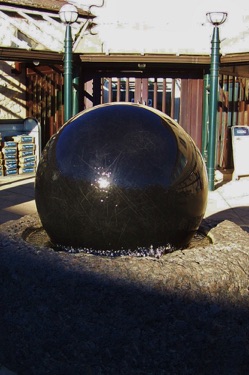
A lovely wander along the rollercoaster path returned me to the Visitor Centre with its amazing rotating Kugel Stone, a one-tonne spinning sphere of granite that revolves on a thin film of water. There is also a little range of shops as well as the popular Mainsail restaurant that serves up a scrumptious varied menu – and some delicious cakes!
This is not intended as a walk guide.


Green Adventures February 2016
Carsington
Sally Mosley is passionate about the Peak District and likes to pass on her vast local knowledge through guided walks, talks and writing. She has written a regular fortnightly feature for the Peak Advertiser for more than 24 years and is the walks feature writer for Derbyshire Life & Countryside magazine. Her business has been awarded the Environmental Quality Mark accreditation in recognition of her high environmental quality standards in the Peak District National Park, and her fun approach to promoting it!

